
Week – 1
- To be very honest, I have never liked learning history because there are too many names and dates to remember. Even so, I went into this class with an open mind.
- What is history? and why do we study history? History is a record of a series of events that occurred in the past. The time period where we do not have written records of events is called pre-history. We study history so as to learn from it and not repeat the mistakes of the past.
- Ṭhis class we learned about pre-history and its 3 time periods: paleolithic, merolithic and neolithic.
- We also learned about OTZI ‘the iceman’, the discovery of farming, forming a society and cities, the cities of Jeriko and Catal Hoyok, stratification of layers and the epic of Gilgamesh.
- Even though I am not the biggest fan of history, I learned a lot and did enjoy myself. In my opinion, history is much more fun when we look at it as a story and not just a bunch of dates and names.
Week -2
- This week we started off by diving into the history of the Indus Valley Civilization. The cities of Harappa and Mohenjodaro were at the centre of this all.
- It was quite interesting to learn about the cultures of the people who lived in these cities and how they lived there.
- We then moved on to learn about the Peloponnesian war which was fought between Athens and Sparta and how it played its role in history.
- I learnt how strategy and the lack of the same can have an impact on the result of any process.
- Learning about these people and their way of living makes you realize how far we have come and how much we have learned from them.
Week – 3
- Rome, aka the city of 7 hills, has a great amount history which is quite peculiar and interesting.
- We looked at just a portion of it in this class. I learned about the 3 wars that were fought between Rome and Carthage that resulted in the annihilation of Carthage.
- I also learnt about the misadventures of Julius Caesar and the betrayal by his dear friend Brutus who was among the few people who were involved in Julius’ assassination thus giving birth to the famous line by Shakespeare, “Et tu, Brute?”
- It taught me how easy it was for people to betray their close friends for their personal interest.
- I learnt how Istanbul came to be which used to be called Constantinople after the first Christian Roman Emperor “Constantine”.
- Romans were a very strong-headed bunch which is why they were successful in winning majority of the wars they fought and conquer various regions. And that is what I took away from this class, how determination and careful planning can help one in succeeding.
Week – 4
- This week we talked about Phoenicia aka the fertile crescent, which existed from 1300 BC to 300 BC. It consisted of cities of Sidon, Tyre, Carthage and Babylon. The residents of this place were known as the Canaanites and they had a semitic culture.
- People from Phoenicia worshiped a god named Baal. The statue of Baal was always depicted with his right hand up as if pointing towards the sky. He was considered to be the God of thunder and storm.
- People used to make child sacrifices for their god Baal but then this practice was discontinued and replaced with the sacrifice of goats.
- I also learned about the David’s sacrifice. David was a strong worshiper of Lord Baal and was about to sacrifice his son Isaac for him.
- This class taught me the various beliefs of the people in those times and how that influenced their actions and their way of living.
Week – 5
- This class we peaked through the window of Egyptian history.
- I learned about how Egyptians look at time as linear and circular.
- The Egyptians were very religious and believed in afterlife. For them, their Pharaoh was the god king and Sylus was the king of the underworld.
- The process of mummification was although very brutal, it was quite clever. It showed how science was a part of their religion.
- The pyramids were also very well constructed. It had various fake rooms, traps and illusions.
- Egypt was known for iron mines and also glass work. This was the main source for their trade.
- I learned how smart the Egyptians were and how they lived their life based on their knowledge and belief. They had mastered the skill of trade and were skilled in many art forms. Their understanding of time was also quite interesting to me.
Week – 6
- In this week’s class, we discussed the Roman empire, their beliefs and their army.
- The discussions we had in this class made me understand why the roman empire and its army was so strong.
- I also realized that people’s motivation to expand their empire was to have more power. This is why there were so many wars, to siege another empire and establish control over it.
- The Romans embodied the spirit of war and power and that is seen very clearly through history.
Week – 7
- This week we got briefed on our timeline project.
- For my assignment, I had to select and object and establish its timeline through history and note how it was different in different civilizations.
- I had to write about 8 such civilizations.
Week – 8
- This week, I presented my timeline project in front of the class. Public speaking has always given me the nerves which is why this was a bit tough for me but at the same time it made me a bit more comfortable with the idea of speaking in front of so many people.
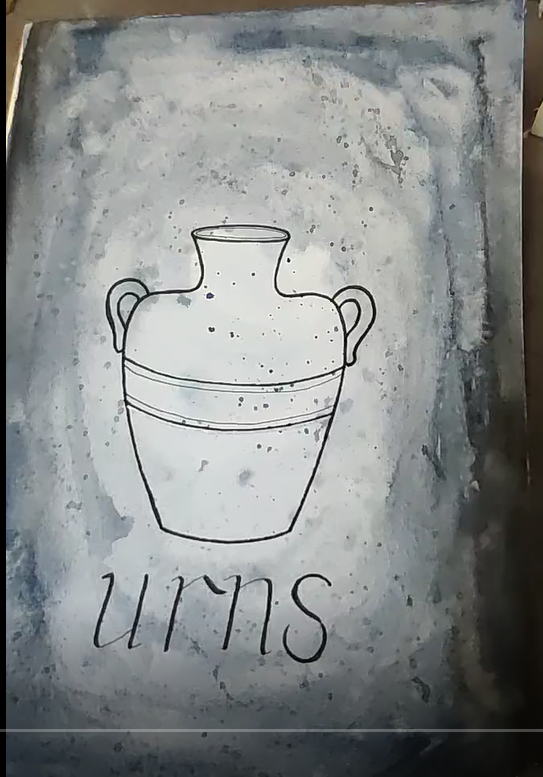
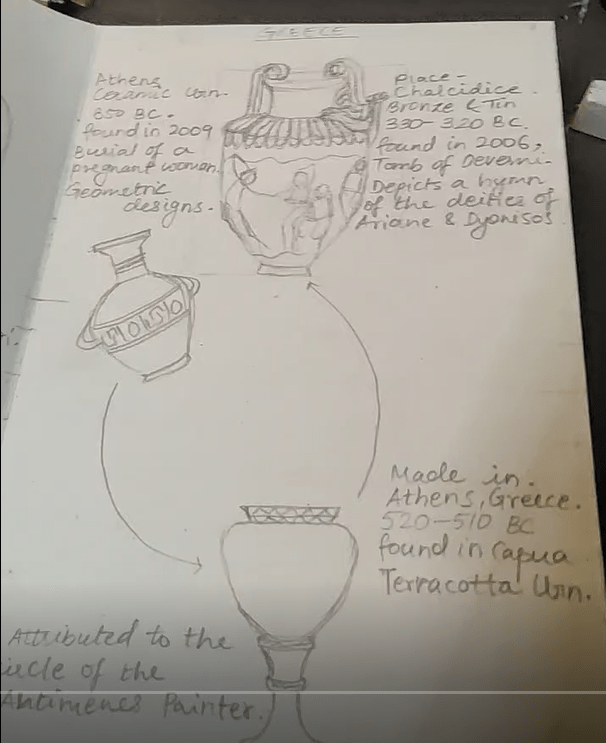
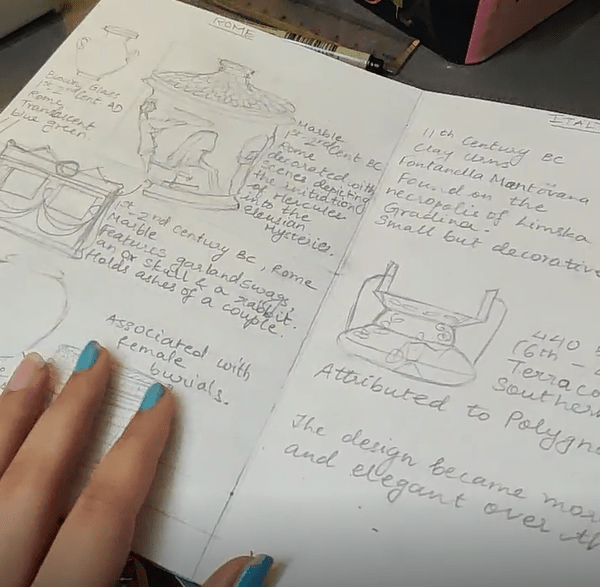
- My timeline was about urns.
- I wrote about the different urns that were found in different civilizations and how they were different in their form and purpose.
- Doing the research for this was very insightful. I realized how the designs of the urns are different from the ancient times. Urns found in the ancient times were more decorative and story telling where as now we have plain yet sophisticated urns which do not feel personal due to the lack of engravings.
Week – 11
- This class, we learnt about the history of India.
- We discussed about the vedic kingdoms, the influence of Greeks in India and Buddhism.
- The Gandhara school of art was influenced by the Greeks and the Biddhists.
- I learnt about the class hierarchies and how art flourished and was influenced in India.
- We were the briefed about our next project. We had to make a list of 6 historical objects and categorize them into 6 disciplines.
- The following is my list of objects for the assignment:
Week – 12
- In this week’s class, we discussed religions of Christianity, Judaism and Islam and how they had some similarities.
- We also looked at the Gupta Dynasty, Chanakya’s wit and influence on the rule of the kingdom which was seen in his Arthashastras and his idea of Vishakanyas.
- I learnt the importance of strategies in ruling a kingdom, it made sure that the ruler had his kingdom under control.
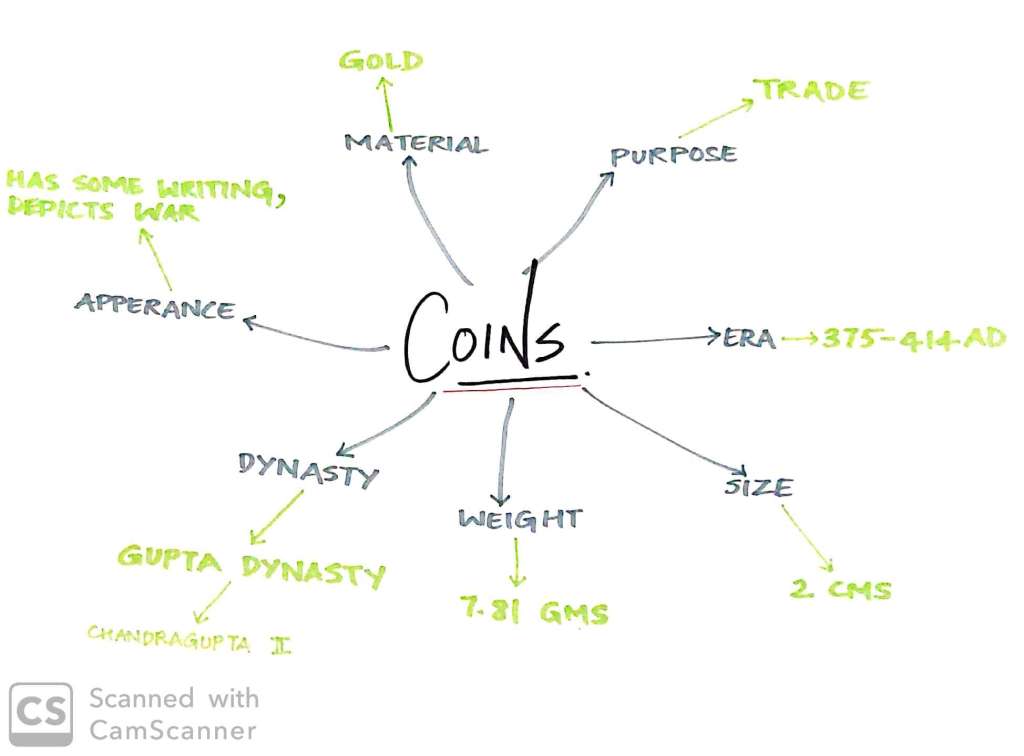
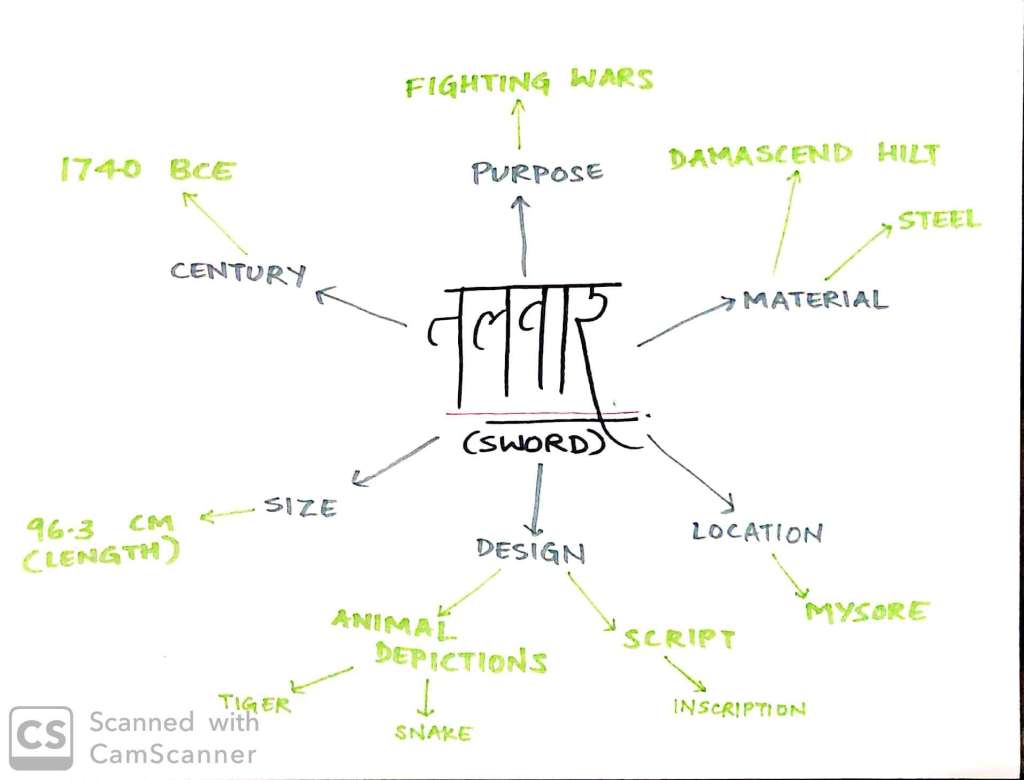
- We were then briefed about the next step of the assignment, which was to make mind maps on the 6 objects we had listed down.
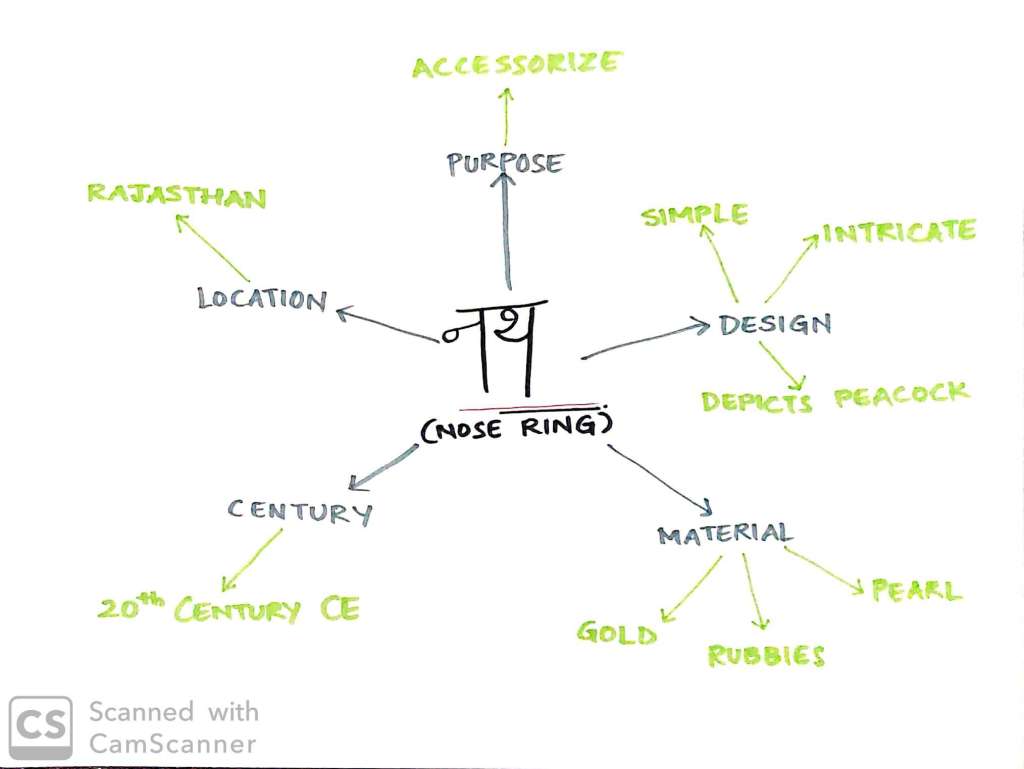
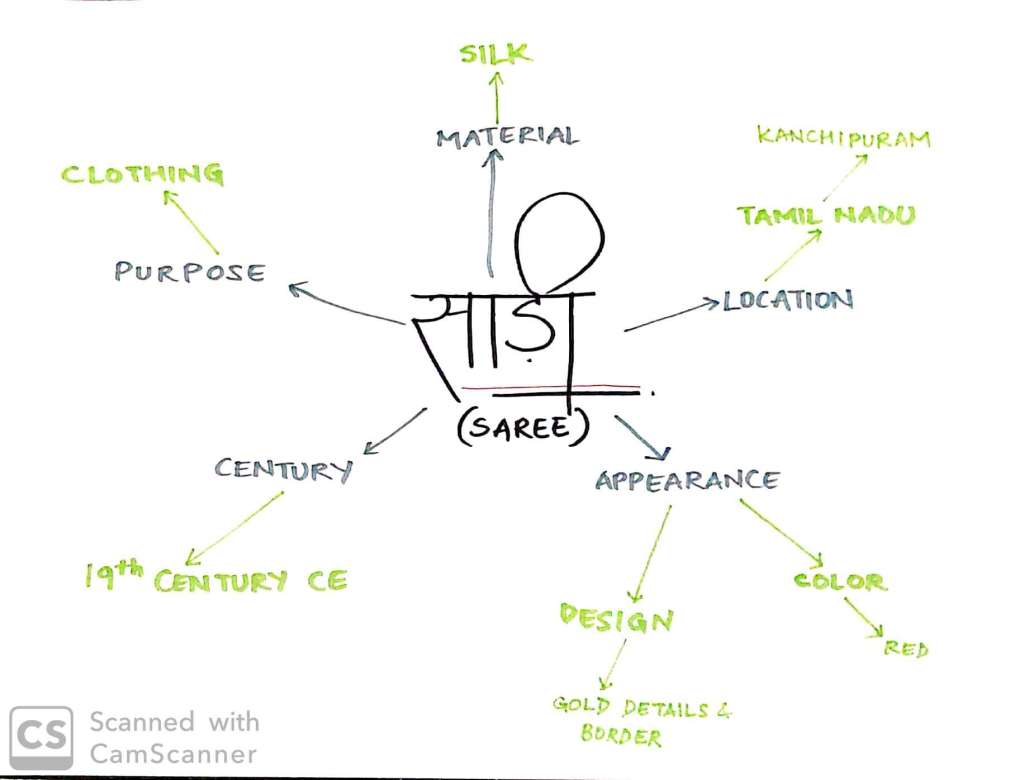
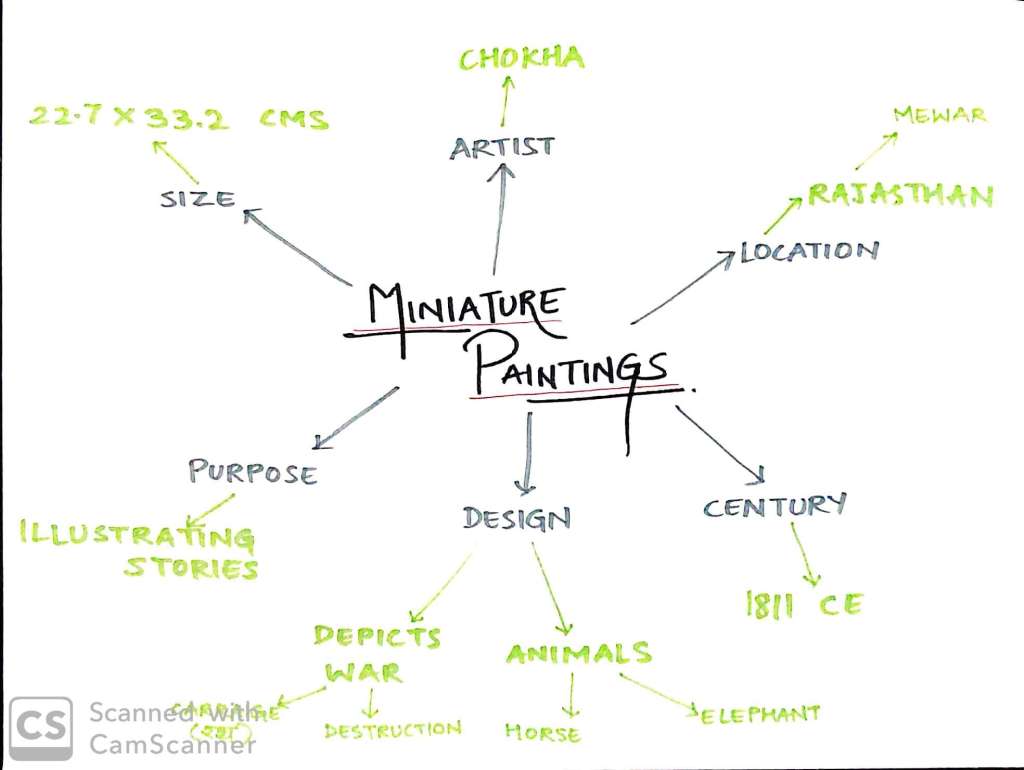
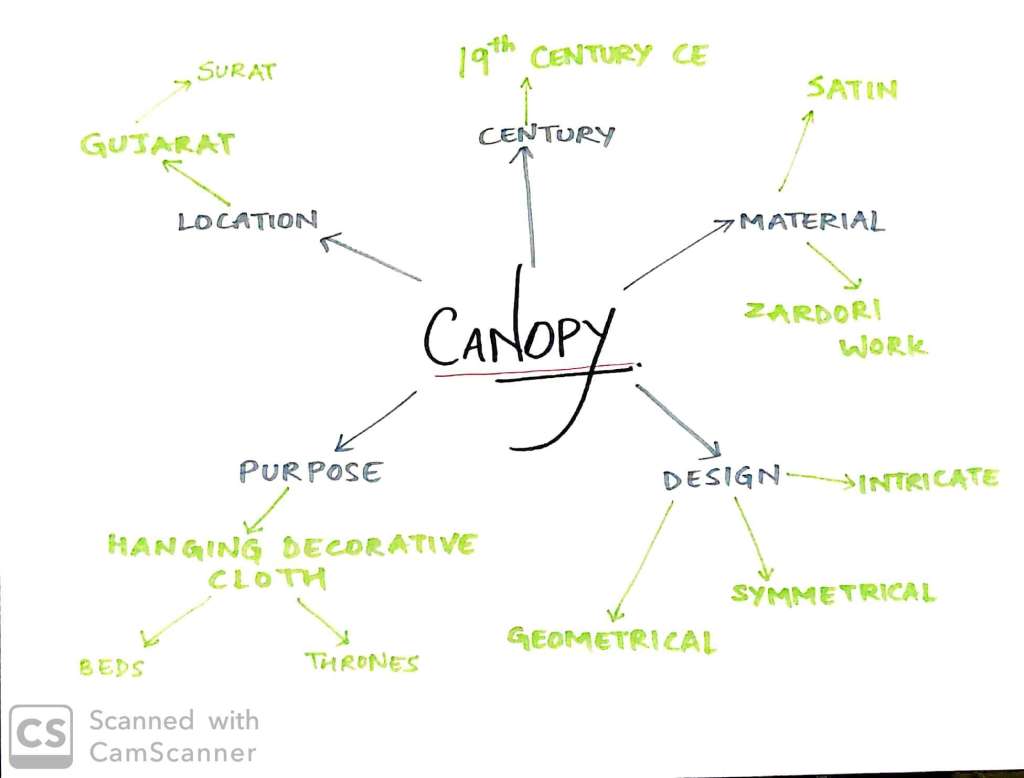
Week – 13
- This week, we studied the Roman Empire’s decline. Roman had expanded their empire too wide were unable to manage it. They had bit off more than they could chew and hence suffered the consequences of the same.
- We then moved on to the Mughal Empire and its rulers. Rulers like Babur, Akbar, Humayu and more.
- I learnt about Akbar’s principles and how he was a just ruler, something I had observed when I watched the movie Mughal-E-Azam.
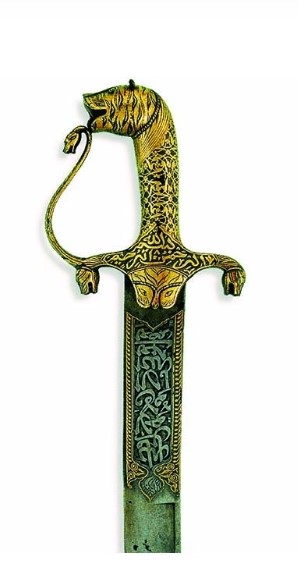
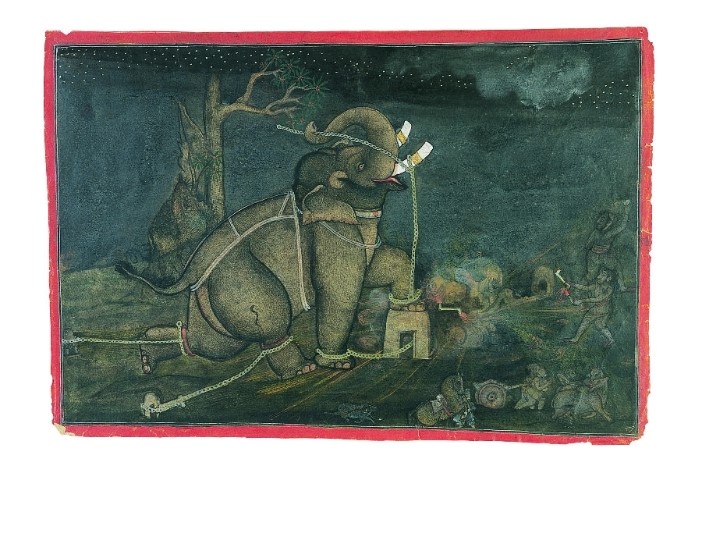
- We then were told how to proceed with the project. We had to pick 2 objects from our list and write 250 words on its design intervention.
- The 2 objects I picked are : Swords and Miniature paintings.
Week – 14
- In today’s class, we discussed the Maratha rule and the various people who had an impact on its establishment and expansion.
- We then spoke about World War 2 and the situations of different countries during that time.
- I learnt a lot about Hitler and his unjust or inhumane practices on the Jews.
- I learnt that people are easily influenced and misguided by a person who has power and blind faith of the people.
- This week, I wrote my design intervention for my objects : Sword and Miniature painting.
Week – 15
This week was the review week. I was quite happy and satisfied with the work my group had done. Once we were done writing our concepts, I compiled all our work into a book.

 Different Strokes